St Patrick's Primary School
Week 21 Adverbs Adding <_ly> to adjectives
Learning Intentions
�� To develop an understanding that many adjectives can be made into adverbs using -ly
�� To revise all parts of speech.
�� To parse sentences.
�� To revise how a prefix or suffix, when added to a word, can change its meaning and the kind of word it is.
�� To revise comparatives and superlatives
Introduction
Let’s revise nouns and adjectives, verbs and adverbs.
week-21-adverbs-adding-ly-to-adjectives


Write these sentences into your literacy book and parse using the correct colours.
The children thoroughly enjoyed a delicious ice cream.
My delightful puppy snuggles happily on the sofa.
Main learning
Look at this word. slow
Let’s think of a sentence with the word ‘slow’.
Now add the suffix <-ly> to slow and write a sentence
Here is an example
I got the slow train from Portrush to Coleraine.
The train travelled slowly from Portrush to Coleraine.
Compare how the two words are used in the sentences.
Compose more sentences with the words. Write neatly into your literacy book.
�� quick, quickly
�� dangerous, dangerously
�� anxious, __________
I felt ________ before the race.
I waited _________ for the race to begin.
Usually you just need to add <-ly> to the root word but there are some exceptions.
If a word ends in <y> like shy, then replace <y> with <i> before adding the suffix <-ly>
If a word ends in <le> like gentle, then remove the before adding the suffix <-ly>
If a word ends in <ic> like magic, the suffix <-ally> is added instead of <-ly>
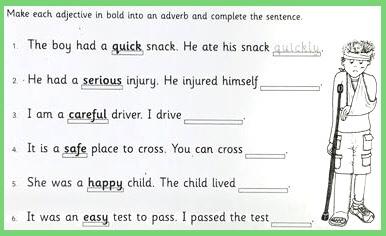
�� Now change these adjectives into adverbs and write a sentence with each word into your literacy book. Underline the adverb in orange.
polite, calm, perfect, graceful, regular, unexpected, continuous, shy
It is important to remember that not all words that end in <-ly> are adverbs.
Look at these words and discuss what part of speech they could be.
friendly, lonely, lovely
Also many adverbs do not end in <-ly>. Look at these examples.
The boy spoke well at assembly last Friday.
I will be late for my train.
My mother arrived soon.